2012年4月29日星期日

Week 4 - Humanism and contemporary sculpture

Ron Mueck's sculpture and Humanism 

Mask II (2002) Ron Mueck

A girl (2006) Ron Mueck

Ron Mueck has become internationally recognised for his unique sculptures, which replicate the human figure with unrivalled technical skill. His work has a powerful psychological range, focusing not only on universal experiences like birth, life and death but on emotional states such as isolation, fear and tenderness. His startling manipulations of scale are key to our experience of each work.


Mueck's work showed at the Christchurch Art Gallery from the end of 2010 through to January 2011. Research Mueck's sculpture in order to answer the following questions


1. Mueck's sculpture is described as 'hyper-real'. Define the meaning of this term and explain how it is evident in his work.

The meaning of 'hyper-real' is something Exaggerated in comparison to reality and Extremely realistic in detail. It is evident in Mueck works with a particular type of hyper-real sculptures that has a long history. He invites people to take a close-up look at his work, to inspect the hairs, freckles and blemishes, to scrutinize the carefully modelled expression and contemplate the difference between artist-made reality and the world in which we live.


2. Mueck says he is not interested in making life size sculpture. Find out why he is more interested in working with the scale of the figure which is not life size, and mention 2 works which use scale that is either larger or smaller than life.


Mueck is more interested in working with the scale of the figure which is not life size, according to Mueck:"I never made life-size figures because it never seemed to be interesting. We meet life-size people every day.'" He really put his feelings into the work so that's the reason why his sculpture pretty eye-catching. Mueck break the rule and made a new trend with 'hyper-real' and jump out of bandage with life size sculpture. Mueck said''There's no denying that I have more information readily at hand when I have a live model. Even when I have had a model, however, what I have to do in the end is to consciously abandon the model and go for what feels right.''


Mention 2 works which use scale that is either lager or smaller than life:
first, In Bed(2005)as a 21 foot long “colossal tableau” and goes on to explain “its size distracts from its emotional intensity”.


Second, Two Women(2005). This sculpture only half child tall.  


http://www.sculpture.org/documents/scmag03/jul_aug03/mueck/mueck.shtml


3. Define Renaissance Humanism , and identify which aspects of Humanism can be seen in Mueck's work. Note that the contemporary definition of Humanism is much broader than the Renaissance definition.

Humanism is the characteristic intellectual movement of the Renaissance.
Humanism is a psychological approach that emphasizes the study of the whole person. Humanistic psychologists look at human behavior not only through the eyes of the observer, but through the eyes of the person doing the behaving.   
Renaissance Humanism is the spirit of learning that developed at the end of the middle ages with the revival of classical letters and a renewed confidence in the ability of human beings to determine for themselves truth and falsehood. 
Nowadays artist's mind and thought more open and freedom, just like Ron Mueck's sculpture. He shows the spirit of the feelings that the world should be more interesting, we need meet fresh thing everyday. It reflects by his sculpture which no one made in life size.


                                          http://www.simplypsychology.org/humanistic.html   


4. Research and discuss one of Mueck's sculptures that you might find challenging or exciting to experience in an art gallery. Describe the work, upload an image of the work, and explain your personal response to the work. Comment on other student blogs to develop the discussion around the variety of our own personal and individual responses to art and design.

A girl (2006) Ron Mueck


A girl (2006) is my favorite sculpture.It reproduce the minute detail of the human body, but play with scale to produce disconcertingly jarring visual images. He explore the full life cycle, encompassing birth, adolescence, procreation middle age, old age, and death. A girl is incredibly special because she looks so real. I even can see her thin hair. Also I really interested the expression on her face, she looks like deeply thinking something. That all I want to investigate more about Ron Mueck and his sculpture.

http://avaxnews.com/wow/Sculptures_by_Ron_Mueck.html  


2012年3月18日星期日

Week 3 - Damien Hirst's work 'For the Love of God' and Mercantilism

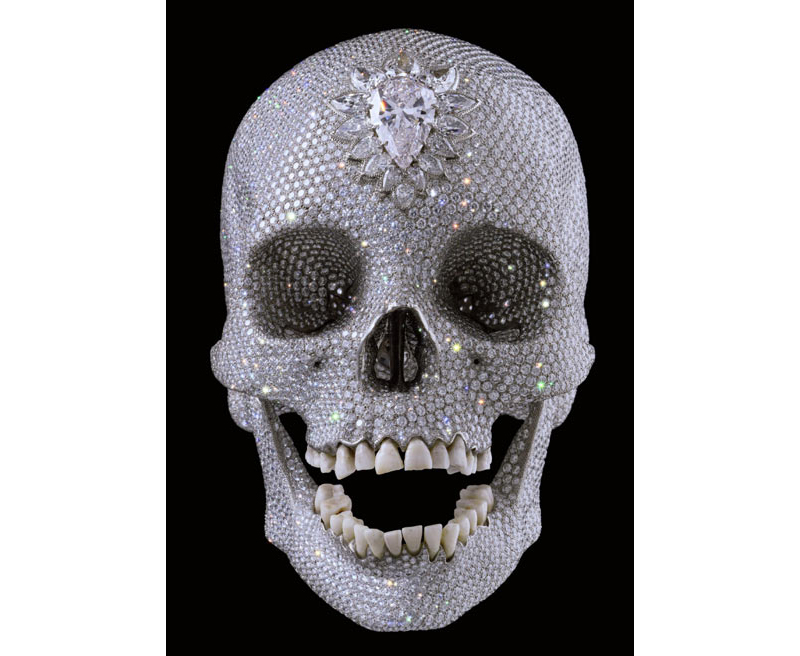
For the Love of God(2007) Damien Hirst
 
Research Damien Hirst's work For the Love of God (2007) in order to answer the following questions;


1. Describe the work, giving details of the form and materials.

'For the love of God' created by Damien Hirst in 2007. It is a platinum cast of an actual 200-year-old male adult human skull that Hirst picked up in a London taxidermy shop. He created the Expensive head infrastructure, then he used 8,601 diamonds weighing more than 1100 carats like he was spreading seeds on a Chia Pet. The single large diamond in the middle of the forehead is reportedly worth $4.2 million alone. Set in the middle of the forehead and breaking up the even pattern of smaller jewels that follow the exact contours of the bone is a large, pear-shaped diamond surrounded by smaller diamond petals.At the end of work Hirst took the real human teeth from the original skull and set them in the jawbones of the skull.


2. What does the work mean? What is Damien Hirst communicating in the work?

The Diamond skull never shows in the art history, it is a fresh eye-catching work which represents a traditional "memento mori", an object that speaks of the transience of human existence. According to Rudi Fuchs: "The skull is supernatural, almost heavenly. Proclaims victory over decay. At the same time represents death as something infinitely more relentless. Compared to the tearful sadness of a vanitas scene, the Skull of Diamonds is pure glory. "  That's how communicated to Damien Hirst, he proved how human existence with gorgeous life, just like he said:"I wouldn't mind if it happened to my skull after my death."                                                                                                                                                                                                                                                                                                                                                                                                                                                                                                                                                                                                                                                                                  http://www.artquotes.net/masters/hirst/for-the-love-of-god.htm 


3. How does Hirst's diamond encrusted skull relate to Mercantilism and to conspicuous consumption?
Mercantilism advocated that a nation should export more than it imported and accumulate bullion (especially gold) to make up the difference. The exportation of finished goods was favored over extractive industries. "For the Love of God" is one of the most controversial works by the artist and was sold to a group of collectors in 2007 for $100 million. The skull contains more than three times the diamonds than the British Imperial State Crown. When the skull was shown at the White Cube gallery in London in 2007 in its own room, dimly lit with carefully placed lights, people were allowed in by ticket in groups of ten for five minutes at a time.


 http://www.escapeintolife.com/essays/for-the-love-of-god/


4. How much did the work cost, and how much was it sold for, and who bought it?

The skull cost $20 million to make, including diamonds and fabrication. London’s White Cube gallery announced that British artist Damien Hirst diamond-encrusted skull sold for $100 million dollars, a record price for work sold by a living artist.

http://www.artknowledgenews.com/Damien_Hirst_For_The_Love_Of_God.html 


5. What are some of the differing opinions of the journalists in the newspaper and blog articles?
   What did they think of the work?


Damien Hirst is not the world's greatest current artist. But he's probably its savviest. Hirst explores the uncertainty at the core of human experience; love, life, death, loyalty and betrayal through unexpected and unconventional media. art historian Rudi Fuchs has said, “The skull is out of this world, celestial almost. … At the same time it represents death as something infinitely more relentless. Compared to the tearful sadness of a vanitas scene, the diamond skull is glory itself.”


6. Based on your research, what is your opinion of the work, as an object or a work of art.


 I strongly agree "For the Love of God"as a work of perfect art. Due to skull's mysterious no body created this form before, until Hirst broke the rule.  I think most people would agree that their skulls are a priceless asset. But what artist Damien Hirst has done to the following skull has actually made a nondescript skull into one of the most expensive pieces of art ever. He created by cost $20 millions after he could gain more and more. That's a really good expel for me to known what is Mercantilism about and how he can be so succeed.     


2012年3月9日星期五

Week 1- Mercantilism and Fiona Hall's work


'
Tender' (2003-05) Fiona Hall

Fiona Hall's contemporary work reflects ideas that come from the Renaissance concept of Mercantilism.

Research the two examples; 'Tender'(2003-05) and 'Leaf Litter'(1999-2003) to explain how they relate to this concept.


1. First define mercantilism, using material from your ALVC handbook, and explain how it has developed since the Renaissance.


Mercantilism,economic system of the major trading nations during the 16th~18th cent.,based on the premise that national wealth and power were best served by increasing exports and collecting precious metals in return. It superseded the medieval feudal organization in Western Europe,especially in Holland,France,and England. 


Mercantilism was the dominant school of thought in Europe throughout the late Renaissance and early modern period (from the 15th to the 18th century). Mercantilism encouraged the many intra-European wars of the period and arguably fueled European expansion and imperialism — both in Europe and throughout the rest of the world — until the 19th century or early 20th century.Therefore,as a codified school, mercantilism's real birth is marked by the Empiricism of the Renaissance, which first began to quantify large-scale trade accurately.


The Columbia Encyclopedia, Sixth Edition.(2005) Mercantilism. Retrieved Mar 09,2012
from: http://www.bartleby.com/65/me/mercanti.html


http://en.wikipedia.org/wiki/Mercantilism


2. Identify the ideas or concepts in Hall's work that relate to Mercantilism? 


Trained as a painter, Fiona Hall has embarked on a career where her curiosity about and delight in the cornucopia of materials available to contemporary visual artists continues unabated. There can be the concepts that a great deal of the immediate appeal of Hall's work lies in the ways in which she takes the ordinariness of everyday materials and transforms them in her work that relate to Mercantilism.


http://www.artlink.com.au/articles.cfm?id=2280


3. For each work describe the shape, form and materials used, and also explain the ideas behind each example. 


"Tender", made by United States dollar bills then creative a collection of birds’ nests,  a commentary on the effects of modernization, global trade and deforestation. They’re incredibly realistic because Fiona Hall delights in transforming familiar materials, such as glass beads, banknotes or video cassettes into exquisitely crafted works of art. So Tender showcasing Fiona Hall's extraordinary talent and revealing her passionate curiosity about the world.

"Leaf Litter", explores the boundaries between the natural and the man-made with subtlety and humour. Fiona Hall seems also to be telling us that there are some things that no amount of money can buy. In this work, she again reminds us of the fragile diversity of the natural world and shows how the global plants cape has been shaped by human economic “needs”. 


 ' Leaf Litter' (1999-2003) Fiona Hall


  http://www.artgallery.sa.gov.au/agsa/home/Exhibitions/Past_Exhibitions/2005/fionahall.html


http://stilgherrian.com/sydney/fiona_hall_force_field/


4. In your opinion do the materials communicate the ideas of the work? Please explain your answer. 


In my opinion, I do agree the materials communicate the ideas of the work. The Art of community based on materials such as photography, painting, sculpture and installation. Due to these different materials practiced I can see which one is my best masterwork and then I will develop the process and find my personal style with plus deep thinking. 


5. Fiona Hall's recent project The Kermadecs focuses on issues around the Pacific ocean. Research this project to summarize the importance of the area and upload an image to your blog for discussion. 


Kermadecs

‘Kermadec’ showcases a diverse collection of artworks from nine leading South Pacific artists inspired by their voyage to the Kermadec region of New Zealand in May 2011.

The Kermadecs are the most remote part of New Zealand. Despite their natural and historicalsignificance, our awareness of the islands and surrounding waters is slight. The Kermadec Initiative is a project of the Global Ocean Legacy programme of The Pew Environment Group. This initiative seeks to raise awareness about one of the greatest, least known natural wilderness areas on the planet.


australia.gov.au/about-australia/australian-story/fiona-hall
www.qag.qld.gov.au/__data/assets/pdf_file/.../Fiona_Hall_EdKit.pdf 
www.cultureandrecreation.gov.au/articles/fionahall/